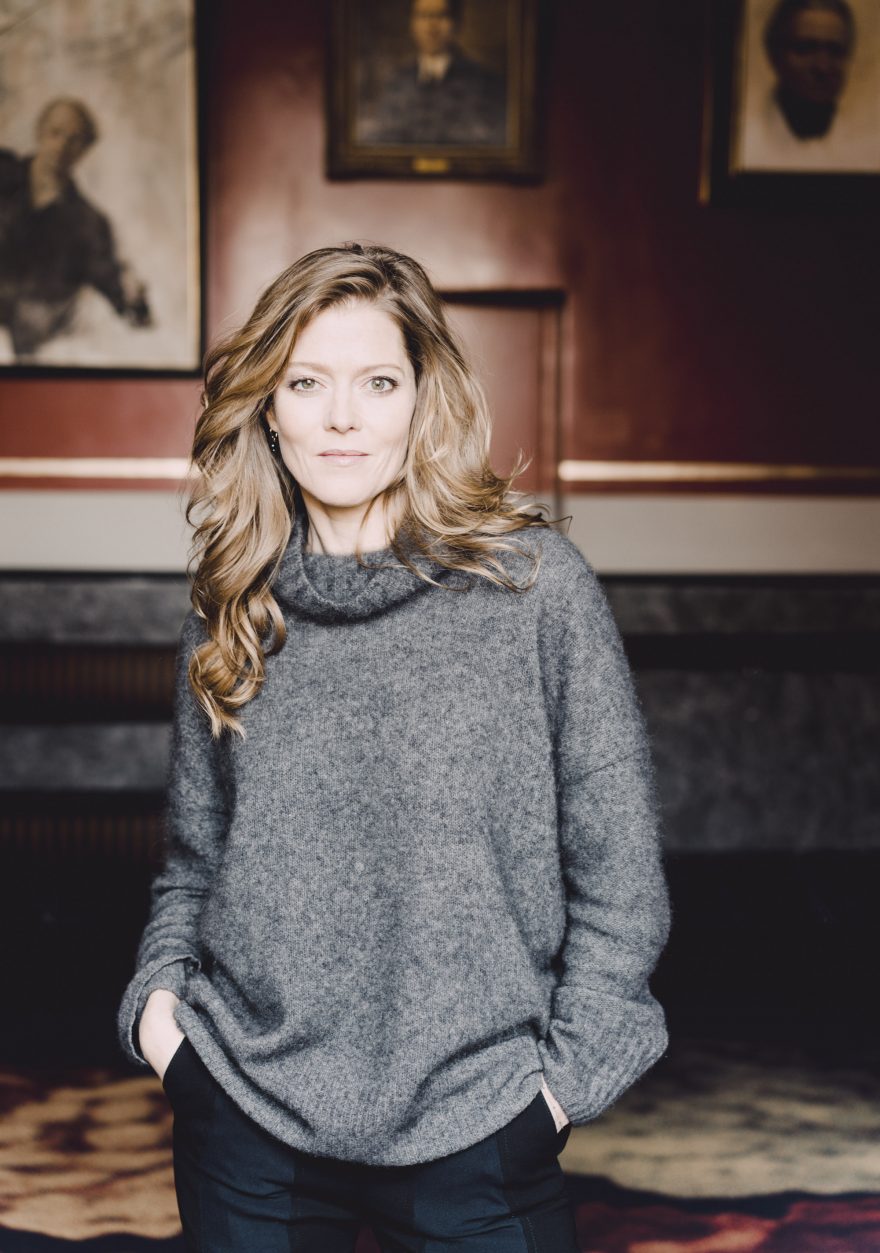
(Photo: Marco Borggreve)
10th July 2020
Embodying music with an unparalleled dramatic sensibility, soprano and conductor Barbara Hannigan is an artist at the forefront of creation. Her artistic colleagues include Simon Rattle, Sasha Waltz, Kent Nagano, Vladimir Jurowski, John Zorn, Andreas Kriegenburg, Andris Nelsons, Reinbert de Leeuw, Esa Pekka Salonen, Christoph Marthaler, Antonio Pappano, Katie Mitchell, Kirill Petrenko, and Krszysztof Warlikowski.
As a singer and conductor the Canadian musician has shown a profound commitment to the music of our time and has given the world première performances of over 85 new creations. Hannigan has collaborated extensively with composers including Boulez, Zorn, Dutilleux, Ligeti, Stockhausen, Sciarrino, Barry, Dusapin, Dean, Benjamin and Abrahamsen.
Last season marked the beginning of her Principal Guest conductor role at Gothenburg Symphony. She also had conducting and singing engagements with London Symphony Orchestra, Toronto Symphony Orchestra, Swedish Radio Symphony Orchestra, Münchner Philharmoniker, and was artist in residence at Orchestre Philharmonique de Radio France. Hannigan also premièred the role of Gerda in Bayerische Staatsoper’s production of Hans Abrahamsen’s The Snow Queen.
For the 2020-21 season, Hannigan will continue her collaboration with the Gothenburg Symphony and Orchestre Philharmonique de Radio France. She will also conduct Bamberg Symphony Orchestra, Munich Philharmonic, Los Angeles Philharmonic, LUDWIG and the Danish National Symphony Orchestra, as well as tour with the London Symphony Orchestra under the baton of Sir Simon Rattle. She will return to the Bayerische Staatsoper to reprise her role of Gerda in The Snow Queen, will sing and conduct Poulenc’s La Voix Humaine, and give the world premiere of Gerald Barry’s new opera Salome as both title role and conductor.
Hannigan’s album as both singer and conductor, Crazy Girl Crazy (2017), won the 2018 Grammy Award for Best Classical Solo Vocal album. Other recent albums include Vienna: fin de siècle, and Satie’s Socrate, both with pianist Reinbert de Leeuw. In spring 2020 she released her latest album on Alpha Classics, La Passione with works of Nono, Haydn and Grisey.
In 2020 Barbara launched Momentum: Our Future, Now, a major international initiative driven by leading artists supporting younger colleagues. She also continues her acclaimed work with Equilibrium Young Artists mentoring initiative, which she launched in 2017. May 2021 will see Hannigan awarded the prestigious Léonie Sonning Music Prize.
Before we start, I just wanted to check something (for the readers). I’ve seen scores entitled ‘Symphonic Excerpts from Lulu’. Is that exactly the same score as the ‘Lulu Suite’?
Yes, that is the Lulu Suite. With the five movements: Rondo, Ostinato, Lied der Lulu, Variations and Adagio.
Great. So, to go straight for the jugular, how on earth do you go about preparing to both sing and conduct a piece like this?
Well, it’s interesting. Of course, conducting a thirty-five minute piece this complex was a huge undertaking for me, even though I’d already sung the suite with Vladimir Jurowski,[1] and sung the whole role in the 2012 production at Le Monnaie, Brussels.[2] I hadn’t done my second production of Lulu yet, so it wasn’t as if this was a role that I had sung every year for the past ten years.
To conduct a piece like this, you have to go into a very deep analysis of the score. I think the most important thing with Lulu (and with many other works written in this era using the same method) is that each character: Lulu, Dr. Schön, Alwa, the Schoolboy, the Athlete, Schigolch, Geschwitz etc. has their own tone row. I think of it as their theme song. The first thing I was advised to do, learning the opera as a singer, was to learn everybody’s tone row, forward and backward. Once you know them, you always know to whom you are referring. In some moments Lulu will sing Dr. Schön or Alwa’s material to them; Lulu is a kind of mirror for every character. After that you also have to learn the Erdgeist/Earth Spirit theme (which consists of two consecutive fourths). Then you have to become familiar with some of the other chords that represent things like the painting, for example. That’s what I did when I was preparing to sing Lulu, and it stood me in good stead. Once you know a tone row well in either direction, you know how it’s going to continue. It’s an extremely intelligent, methodical and disciplined way of learning the role.
So then, as a conductor, as soon as I opened the score for the Lulu Suite I was looking for the hauptstimme (primary voice) and nebenstimme (secondary voice) in each section. This is the way Berg constructs the music in the opera. He marks this all through his scores (Schoenberg did the same thing) with an H or an N so you know who he feels is the main and secondary voice. Anyone else is less important. I dealt with the score in this very analytical way according to these rules: whose tone row; what is the harmonic structure; who has hauptstimme; and who has nebenstimme.
Even though I only sing in the third and final movements, all the material is taken from specific parts of the opera. The opening Rondo, for example, is mainly material from the second and third act – very little is from the first. If you place it well you know exactly what was happening in the opera at that time, even though no one is singing. The most important thing in this suite is to tell the story. All my efforts to analyse and understand the direction, the shape, the hauptstimme, the nebenstimme, whose tone row etc. are so I can tell the story. And for the story we need character, so really it’s all in the development of character.
One amazing thing that I learned is that Berg not only writes the tone rows on a horizontal line (that’s how we sing, right?) but he also writes them vertically, lining them up one on top of each other. That just blew me away. The third way, which is even more extraordinary, is that he does it diagonally. I was in a state of absolute awe at how he was able to compose using such an intricate and disciplined structure, and yet the piece is so completely emotional. It just breaks your heart.
Then I think about how I’m going to tell the story. I was in a pretty unique situation. Anyone who has sung the role of Lulu belongs to a very special club. If you’ve managed it and survived, it’s already something. But then to conduct it…
Right. You didn’t really have many friends to call on about that, I imagine.
(laughs) No. To sing it you’ve lived her life and death, so to conduct it is extraordinary. I’ve conducted it with quite a few orchestras now, and recorded it. I realised that I kind of become Lulu showing us her life. It’s Lulu that’s telling the story, and that happens even more in the second half of the piece (from the third movement onwards) when I turn around to the audience. But even in the beginning I’m still thinking about it in a dramaturgical way.
When I come on stage and I start, it’s Barbara conducting, and then at a certain point Lulu infiltrates and she takes over more and more until I become her. Then she never leaves until the very end of the piece when I sing ‘Lulu mein engel’ on the last few pages [p.137] . This is normally the Countess Geschwitz’s line, so I made two decisions about it. Number 1: I don’t think of it as Geschwitz’s line, I think of it as Barbara’s line, and Number 2: I don’t turn to the audience at the end when I sing it. [3]
I noticed that. I wasn’t sure if it was something to do with the orchestra needing you.
No, no. It’s because it is a kind of disembodied moment. I had a conversation with Sir Simon Rattle about the piece, and I think it was his idea that I shouldn’t turn around to the front, and instead sing to the orchestra. I have had occasions when I don’t sing to the front in other pieces as well, but with this piece I thought that was a brilliant suggestion. So I sing it to the orchestra and let it be lontano (which means ‘far away, as if from a distance’). I wouldn’t do it any other way now.
I watched the talk you did on Lulu at the Southbank Centre.[4]
That was before I conducted it.
Yes, 2013. I thought it was interesting that you said you feel as if you’re singing the voice of both Lulu and Berg. When you throw being a conductor into the mix (just that little extra thing you’re doing there) how many people are inside you then?
(Laughs) Well, I think everybody’s altogether. As far as the conducting of it goes, there is a character who enters and takes control of the piece – that is mainly Lulu/Berg. It shows the orchestra what they need. That is the dominating force, because this music is all about character. Otherwise it just sounds like modern music. All the time you are showing them the story.
That really came across when I watched you conducting it. It felt like you were giving the audience a different route into the music.
I was also interested in the comment you made about being left with both Stockholm Syndrome and Survivor Guilt after singing the role. How do you feel after conducting it?
Well, it’s not the same when I conduct it. Singing the whole opera is such a marathon and it’s completely overwhelming. It’s exhausting – you just can’t do anything else. But when you conduct a programme like this it’s usually just one of four or five pieces on a programme, so in that sense I have to let it go and move on to the next piece.
I love this suite. Even when I sit here and open the score and see all my little notes, I think ‘when am I going to conduct this again?’ I was supposed to sing it in April in Denmark,[5] so I don’t know when I’ll sing it again. I was supposed to sing the entire role in May in Cleveland.
Oh yes, the concert performance. I’m sorry to hear that.
Well, I’ll sing the opera again in a couple of years, so I know that I’ve got another crack at it.
People often refer to the balance Berg strikes between portraying the emotional lives of the characters and the intellectual complexity of the work. When you’re rehearsing and conducting Berg, do you balance both approaches?
When I’m conducting I do let them know. Basically, the way I start any rehearsal is by running the whole piece. I don’t stop unless there’s a train wreck. I don’t do the third movement because I save that until the end. I usually do the Ostinato (the second movement) under tempo because it’s very difficult – I do it slower and at a lower dynamic the first few times. I tell the orchestra what’s happening in each movement because I realise that they like to know and it gets them interested. I might say to the saxophonist ‘you realise you’ve got Alwa’s theme. You’re my half-brother/lover and you’ve been in love with me your whole life’. Or I’ll tell them what the text was at that moment, and what’s happening in the story.
That’s especially true in the first movement, because it is very full, and leaps forwards and backwards in memory and time. I tell the orchestra that. I say that we are on either side of before and after when Dr. Schön has died, it’s like a mirror. I will sing their tone rows to them if I think it’s important so that they familiarise themselves with them.
When I get to the Variations, I tell them they happen in Paris. The Variation song [bar 45] wasn’t even Berg’s melody, it’s actually a song that was written by Wedekind that Berg set. For the Adagio I tell them how it begins with Geschwitz groaning and saying ‘I want to kill myself’ and thinking about all the different options of suicide she has. Finally she says ‘just let me speak to your heart and have pity on me’.
At bar 44 [p.123] in the final movement they have to know that this is when Jack the Ripper and Lulu have entered the shabby little flat. The orchestra needs to know that the love theme with Lulu and Jack is Dr. Schön’s theme. I explain what happens and how it happens. It’s almost like a slow Bach chorale/death march, until we get to bar 78. I explain to them how I’m going to beat it, that it’s going to be very long, and also what Jack says afterwards.
You can feel if an orchestra wants to hear the story or not. In my case, I’ve never found an orchestra that didn’t want to know, so that’s great. Of course, most of them don’t speak German, or if they do they’re so busy looking at their parts that they can’t stop and listen to decipher a long vowel. So I explain the text quite a bit. But I don’t do that the first time I come into an orchestra rehearsal, I just get down to business. It’s when I come back to it and rehearse each movement.
With the third movement I have a few different ways of rehearsing it. One way (because I always have the pianist right in front of me in the orchestra) is that I will sing the Lied der Lulu with the piano reduction, if the pianist is prepared to do so. Then the orchestra can follow their parts and hear exactly how I want to sing it. It’s very helpful for them, instead of trying to follow the conducting, my breath, and so on. They can just sit back and I give them a little ‘Lulu’s aria concert’. Then little by little, as we rehearse it, they become aware of who has the hauptstimme, or the nebenstimme – if it’s in the trumpets, or in the first violins, or the vibraphone. We all learn who to follow. Depending on how self-sufficient the orchestra is I will eventually do less and less, and by the second day of rehearsal I turn away from the orchestra and sing it with my back to them. With some orchestras I don’t conduct it at all. That, I think, is the highest level of achievement. With other orchestras I still have to give some cues and show the tempo. It depends on the concertmaster, it depends on how much the orchestra is used to playing without a conductor. So it’s different everywhere.
With the performance that’s on YouTube[6] I was watching to see if you were giving cues whilst singing. At 17m25s you seem to look to the right for the trumpets, and you toss your head ten seconds later at 17m35s to bring in the horns. Ten seconds after that you use hand gestures that seem to support the violins. Is that all cues for the orchestra?
Yes.
So how does that work? Do you agree with individuals beforehand how you’ll give them a cue, or do they just watch you for a gesture of some kind at a particular point?
It’s the latter. I don’t say exactly what I’m going to do, but they know that it’s for them by that point. We usually spend quite a bit of time rehearsing that third movement until they’re comfortable. It’s a very collaborative way of working because in any piece, when I’m singing and I have my back to them, they have to be quite vocal about it if they’re not comfortable. Normally, many orchestras don’t say anything and are just silent. In this Lied I insist on two things. Number 1: that they don’t accompany me, but are truly in partnership with me. If they accompany me they’ll be late, and Number 2: they have to tell me if something’s not working for them, as once I’m singing a high C or D I cannot hear if they have a problem, because I’ve got so much buzz going on inside my head.
The Ostinato in the suite is the same palindromic section we hear in the middle of the opera. Do you explain all of that to the orchestra?
Well I always make a little joke at bar 37 where we get to the turnaround. I say, ‘see? Now it’s easy – we just have to do it all backwards!’ The Ostinato is really tough – you have to get the right character. They don’t need to know so much about this moment, just the Erdgeist (Lulu’s) theme because everybody’s playing that at the beginning. It’s shimmering through the entire orchestra. The movement is like a manic bee bop. Berg compresses it, which is extraordinary, creating a kind of Doppler effect.
It’s quite difficult around measure 28-29. You’ve got Lulu’s theme bursting out in all these different instruments. It starts within those two bars, and goes from piano and trumpet to trombone, to bassoons and horns, to English horn, saxophone and trumpets again, then to the three flutes, two oboes and clarinet. That is extraordinary. They need to know that’s Lulu’s theme. When they know that, they recognise that they are the hauptstimme. The same thing happens again in bar 45-46 but in reverse. It goes through all the instrumental groups and you’ve got to bring all of those out again. The Ostinato is just an incredible thing to work on – it’s so vivid.
To be honest, as a singer I’m usually offstage at that point during the opera, and I’m often listening to it fall apart. Conductors simply don’t have enough rehearsal time to get the Ostinato as tight and as intricate as they would like. I’m usually half-listening and frustrated while changing costume. It’s very funny.
Does that need a lot more time than the other movements, then?
It depends on the orchestra. It depends on how rhythmic they are.
If you’d like to know more a little more about how I rehearse: once I’ve run through all the movements I usually go back to the beginning of the Adagio, and I work on tone. I work on the rational versus the irrational, the mind versus the heart and the intensity of sound that I need. If the orchestra is able to get that tone, I’m usually really happy. I find that the last movement is so emotional and beautiful that it’s the best one to start with, because everyone will make an immediate emotional connection to that. Then I usually go back to the ostinato and I do technical work, doing it slowly, under tempo and under dynamic. Then I will go to either the first or the fourth movement.
The first movement, as I said, is the hardest. That’s a lot of work and characterisation, so I usually come to that after a break. I won’t come to it before one because they’ll be tired and getting a little bit distracted. The easiest movement, in a way, is the Variations. The trick, again, is balancing the hauptstimme because the horns have the Marquis theme (this is the guy that wants to sell Lulu into prostitution). With the Wedekind song [bar 45] it’s very hard to make sure that we give this frothy Viennese party atmosphere, yet still hear the main voice (which are the dampened horns in the middle), so I work on that. Then the trombones take over this chorale melody.
It’s difficult after that because the trombones, flute, English horn and saxophone take it over, and they’re all quite low in their registers. It has this strange centre of gravity, and then finally ends with a flourish. I usually end the rehearsals with Lulu’s Lied or do it before the break because I often reduce the strings for that. I don’t do it so much anymore, but I used to because it was easier. Now I find that everybody wants to play it, so I just say ‘look if you want to play it then you have to play it with more sensitivity’!
So how much did you reduce the strings by?
Well I used to reduce the strings to 10, 8, 6, 5, 4 from 16, 14 or 14, 12 etc. but sometimes I haven’t even had that much. With the LUDWIG orchestra I think I had 12, 10 etc. for the entire work.
The interesting thing is that the third movement is not an aria, it says ‘Lied der Lulu’ (‘Lied’ means song). She never gets an aria in the whole opera. It’s a big statement about her.
You know, that’s also the case with Don Giovanni.
Hmmm?
Don Giovanni never gets his own aria, and he’s a mirror of whoever he’s seducing or manipulating. So if he’s with a character from the lower class he will sing simple folk-like melodies, and when it’s the elite the music is more highbrow. He doesn’t have his own style.[7]
That’s interesting. I never thought of it like that, but it makes sense. I’ll have to let it ruminate a little bit.
Do you think Don Giovanni would prey on Lulu? I’m wondering what would happen if the two mirrors met: the narcissist and the…
…Earth Spirit! Oh she would make mincemeat of him. He wouldn’t prey on her – I think they’d probably just have a really good time!
(Laughs) Have you ever seen the NYPhil digital archive?[8]
Oh yes. I’ve seen a few scores on it, but not this one. My assistant and I were using it to look at different scores of Mahler’s Symphony No. 4 because I was doing a big study on his symphonies during the lockdown.
Ah right. I saw the Lulu Suite score on there, with markings by the conductor Erich Leinsdorf.[9] There are just very occasional notes he writes in, like what pages of the main score the suite refers to, a dynamic adjustment (a diminuendo in the Adagio) or tempo alterations, and he clarifies the rhythms on the last page. He also makes note of where he needs to beat 4 rather than 2 in the Adagio. Do make you make any similar changes?
I only alter the dynamics in the Lied. It’s also because the orchestra’s not in the pit, so I think it’s necessary to balance it a little differently. But I don’t change any other dynamics.
I think it must be incredibly difficult for any conductor to conduct this piece if they haven’t done the whole opera. I can’t imagine how you would get inside it. You wouldn’t understand the material flipping back and forth, especially the first movement. That informs the character, so I think it’s incredibly important.
For you, as the conductor, what are the trickiest parts of the piece?
I think in the first movement the trickiest bits are some of the tempo transitions – the alternating between poco animato and tranquillo. They’ve got to be really well negotiated and have a kind of freedom. It needs a lot of space and character, otherwise it just becomes pedantic. Tempo 1 is 69 and tempo 2 is 54 – you need to have that in your blood so you naturally get this ‘schwungvoll’ movement within it. Then you come to the Hymne on p.38 where the strings are pizzicato and the saxophone is playing Alwa’s song. I always tell the orchestra what’s happening here because Alwa is completely objectifying Lulu. He tells her that he can see through her dress, and goes through each part of her body and writes a little poem to it. It’s really creepy,[10] and has to have that quality to it. On p.42, negotiating all those fermatas is quite important, not everybody stops at the same time. You have to know how you’re going to deal with that. The same thing happens in the Ostinato at the turning point in bars 36-37. This is very important to negotiate well for the orchestra.
The other thing in the Ostinato is the tempo. It says tumultuoso, so I have to stay very calm while they’re just going crazy! I get them to their tempo and then I have really slow down at the middle point and come to a stop. Within five bars we’ve got to get all the way back to Vivace again. It’s a very fast transition and they have really got to play like a big band. Of course, with the Lied there’s this individual responsibility of each player. I usually encourage the orchestra to move more than normal in the third movement. A lot of orchestras are taught not to move when they play, especially string players. They’re taught not to show the beat, and just sit up straight and play. I ask them to do the opposite, I want the section leaders really moving. If the whole orchestra is like a flock of birds that’s wonderful – I really encourage that.
In the Variations there are these molto accelerando moments, changes in tempo and dynamic vertigo. I’m trying to get this swirling around and dizziness into the music, as if you’re in a hall of mirrors and there’s a mist on top of it.
I love that metaphor.
Yeah! Finally, the last movement is particularly challenging because it’s so slow and needs weight. When I first started conducting I had to learn how to deal with that weight, because I don’t have a big boned body. I’m small framed and very fine boned, so I had to find my way to show the weight and the legato. Every conductor is different – some do this in 4 and some do it in 2. The opening of the Adagio is quite difficult, because you alternate between this very, very even tempo – the senza rubato, and the rubato. This is the moment when Geschwitz is singing ‘maybe I’ll die with a knife, maybe I’ll hang myself etc.’. So it has to have that constant switching between rigidity and no tempo. That’s very important.
Brilliant. Well, we’ve covered so much here! When do you think you’ll be conducting/singing this again?
I don’t think it’s going to be soon because it needs such a big orchestra, and my next couple of seasons are already planned.
Ah OK. So what’s the next piece you’re singing and conducting?
Next week! It’s Les Illuminations by Britten.
Wonderful. Thank you so much for speaking with me, this has been really great.
Oh it’s been my pleasure Hannah. It was really nice to look at the score with you!
Bibliography/Recommended Reading
Hall, P. ‘The Progress of a method: Berg’s tone rows for Lulu’ in Musical Quarterly, Fall, 1985, Vol.71, p.500 (20)
Jarman, D. Alban Berg: Lulu (Cambridge : Cambridge University Press, 1991 2008)
Jolly, J. ‘Barbara Hannigan, as both conductor and singer, sheds a unique light on Alban Berg’s Lulu Suite’ in Gramophone, 2017, Vol. 95 (1152), p.129
Perle, G. The Operas of Alban Berg: Volume 2 Lulu University of California Press (12 Sept. 1989)
Perle, G. ‘Some thoughts on an ideal production of Lulu’ in The Journal of Musicology, Spring 1989, Vol.7 (2), p.244
Reich, W. ‘Alban Berg’s Lulu’ The Musical Quarterly, 1 October 1936, Vol.22 (4), pp.383-401
Strykowski, D. ‘The Diegetic music of Berg’s Lulu: When Opera and serialism
collide’ in Journal of Musicological Research, 02 January 2016, Vol.35 (1),
pp.1-22
[1] 27th April 2013, with Vladimir Jurowski and the London Philharmonic Orchestra, Royal Festival Hall, London.
[2] Lulu, Alban Berg. Production La Monnaie/De Munt from 2012. Director Krzysztof Warlikowski, Conductor Paul Daniel.
[3] See https://www.youtube.com/watch?v=XatVOukxxtE – 30mins35s (accessed 1st July 2020).
[4] https://www.youtube.com/watch?v=6AhnOFwfBnM (accessed 1st July 2020).
[5] This performance on 19th April 2020 with the Danish National Symphony Orchestra was cancelled due the Covid-19 lockdown.
[6] https://www.youtube.com/watch?v=XatVOukxxtE (as in fn 3).
[7] This comparison is also drawn by Perle: ‘Berg saw his heroine as a latter-day counterpart of Mozart’s Don Giovanni, and reincarnated conventions of the classical operatic tradition to establish parallels between the musico-dramatic world of the Don and that of Lulu’ (1989: 57). Also ‘… as in Don Giovanni, sexual desire, oblivious to differences of wealth and social position, exposes the artificiality of class distinctions and thus becomes a powerful means of social commentary and characterization. It is Lulu, the natural and therefore innocent woman, who is the connecting link between the world of the banker and that of the pimp, between the world of the aristocrat and that of the beggar, between the world of art and that of the most sordid violence and brutality’ (1989:34).
[8] https://archives.nyphil.org
[9] https://archives.nyphil.org/index.php/artifact/32a69245-17e2-4ff6-b918-4913d1a4828e-0.1/fullview#page/1/mode/2up
[10] See bar 1097 in the score of the full opera for Alwa’s Hymne.