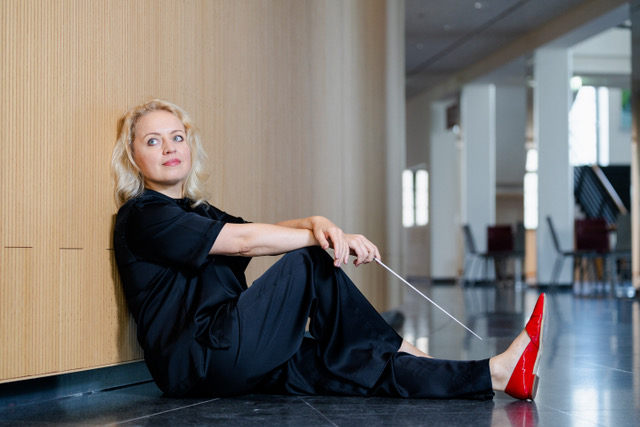
(Photo: Katharina Gebauer)
Conductor, composer, pianist, and synesthete, Anna Skryleva received the prestigious Opus Klassik Award in 2024 and has gained international recognition for her profound and visionary musical work. As a composing conductor, she brings depth and innovative spirit to the ongoing expansion of the classical repertoire.
She attracted worldwide attention in 2022 with the rediscovery and world premiere of Eugen Engel’s opera Grete Minde, widely hailed as the ‘discovery of the century’. During her tenure as General Music Director at Theater Magdeburg (2019–2025), numerous award-winning projects were realized, including the Special Prize’Innovative Orchestra 2019 for her concert programming. In 2022, the production of Grete Minde was nominated for the International Opera Awards, and in 2024 the
Magdeburg Philharmonic Orchestra and Anna Skryleva received the Opus Klassik Award for the world-premiere recording of Grete Minde, additionally earning a nomination in the category ‘Best Opera Recording’.
As a conductor, Anna Skryleva followed the classical path of the German Kapellmeister tradition, beginning as a solo pianist and progressing through positions as répétiteur, assistant conductor, and Kapellmeister, with mentors including Simone Young and the Institute for Women Conductors at the Dallas Opera (USA).
She is a regular guest at major opera houses and with leading orchestras such as the Royal Swedish Opera, Gewandhausorchester Leipzig, DSO Berlin, Copenhagen Phil, and the Frankfurt Radio Symphony. In September, Skryleva achieved great success conducting the world premiere of Anna A. by Italian composer Silvia Colasanti at Teatro alla Scala in Milan. In 2026, she makes her debuts at the Sydney Opera House and the Komische Oper Berlin.
Her repertoire spans from Mozart, Verdi, Wagner, and Strauss to Shostakovich, Britten, and contemporary music. She collaborates closely with internationally renowned soloists such as Andreas Schager, Camilla Nylund, Vida Miknevičiūtė, Arabella Steinbacher, and Felix Klieser. In close artistic partnerships with composers including Master of the King’s Music Errollyn Wallen, as well as Lera Auerbach and Konstantia Gourzi, Anna Skryleva continues to realize groundbreaking projects.
Her own compositions are published by Universal Edition Vienna. Alongside numerous orchestral arrangements, her oeuvre includes works such as Lullaby (2023), 3 Impromptus in C and Mirror (2024). In October 2025, the world premiere of her Scherzo for Horn and Orchestra took place – a work composed for the renowned horn player Felix Klieser and conceived as part of a forthcoming Horn Concerto.
Anna Skryleva lives in Berlin with her family.
—
Anna, congratulations on the release of the first ever Kashperova CD. How many of her pieces have you now conducted? Do you have plans to conduct any others?
Unfortunately, there are not many orchestral pieces by Kashperova. As a student, she apparently composed an overture (which she also conducted herself) and a cantata featuring soloists, choir, and orchestra for her final exam at the St. Petersburg Conservatory. But now we only have the scores of her Piano Concerto and her Symphony. I first conducted the Symphony seven years ago, and I recorded the Piano Concerto with the Symphony for the CD.
You have conducted a lot of rediscovered music, including your award-winning recording of Grete Minde by composer Eugen Engel. How do you like to approach works such as this that have little or no performance history?
The process of getting to know the work is quite different from that of works that already have established performance traditions. As a conductor, you have to ‘hear’ the orchestral sound when studying the score, and then experience it for the first time later on during rehearsals with the orchestra. After all, there are no recordings of such works, and often they require certain refinements – whether in articulation or phrasing. Sometimes there are even a few notes that clearly don’t fit into the harmony.
Every work needs to be performed several times to truly come into its own. Most of the masterpieces we know were performed during the composers’ lifetimes, and it is also common for composers to have made corrections to their works after each performance. There were also often errors in the orchestral scores because copyists back then did not read the autograph scores correctly. Over the decades, various publishers have made their own corrections. To this day, for example, there are still so many unanswered questions regarding Beethoven’s symphonies. But in the case of Kashperova, and especially in the case of Eugen Engels’ Grete Minde, it was quite different. The composers have long since passed away, and I can no longer ask them personally if I may adjust an articulation or a tempo. I have to make that decision by myself.
For me, the most important factors in such decisions are the sound and the total form of the work, and I usually sit down at the piano and check out the harmonies. It is often the case with such works that, due to their limited experience with orchestras, the composers have not specified the dynamics in great detail. So I take the liberty of making a few dynamic adjustments so that the balance within the orchestra sounds more transparent.
I am sure that if I had the opportunity to perform Eugen Engel or Kashperova’s works with the composers in person, I could convince both composers to make a few revisions to their pieces. I often work with living composers and enjoy engaging in direct dialogue about their works. Composers often come up with wonderful new ideas after we have performed the piece together.
Can you explain to us how you prepared for the Kashperova Symphony or Piano Concerto?
When I first received the score for the symphony – it was around 2018 – I realised pretty quickly that it was a very beautiful piece of Romantic music. So I decided to conduct this symphony in my inaugural concert as a Music Director of Magdeburg Philharmonic in 2019. I didn’t have the score of the Piano Concerto at this point, but I already had the idea to make a CD recording of both of these pieces. When I got the score of the Piano Concerto, I played the piano part for myself – I used to be a solo pianist before I started conducting, so of course that helps me to prepare the piano and orchestra pieces. I can try out a few sections to see what the soloist needs from me as the conductor. This piano part is quite challenging! So, from that we can understand that Kashperova was an excellent piano player.
Her piano concerto reminds me a bit of Clara Schumann’s from the structure of the piano technique, but there’s also a chamber music feel in this piece. In the last movement there is a section with solo cello and piano and a couple of bars later added a solo violin it sounds like a piano trio (bars 40-73). There are several places in the Concerto and also in the Symphony where solo instruments interact with the piano soloist or with the orchestra. As a conductor you need to know this feeling as a chamber music player to let the musicians make music together.
Did you do a lot of research into her life, or do you prefer to let the score/music speak for itself?
First I learned the music of Kashperova, and that moved me. Unfortunately, there are not many documents about Kashperova’s life. I suspect there is much more to be found in Russian archives, but today we have no way of communicating directly with Russia.
Balakirev criticised Kashperova’s work and said it wasn’t what a work of the Russian school should sound like. He disliked her orchestration and her ‘unnecessary pursuit of solos’. What do you think about this?
You can find something to criticise in every composer’s music – even Balakirev has his flaws. Of course, Kashperova wasn’t as experienced in her orchestral works. As a composer (and as a conductor) you can only learn by doing, and if you want to compose for orchestra, you also need to have the opportunity to hear your works performed live by an orchestra. Many famous composers have had the opportunity to have their works played through by an orchestra during a few rehearsals before making some revisions. For that, you need your own network. I suspect that Kashperova didn’t have that kind of network with orchestras. She was apparently very active as a solo pianist and chamber musician.
Dr. Graham Griffiths (the academic who discovered Kashperova’s music) loved your recording thought that you had created a concerto for orchestra in your performance of her Symphony. Was this your intention, did you think about the symphony in this way?
That’s interesting feedback – I like it! But for me this symphony has a very clear form as a symphony. It even has some elements of chamber music. There is a great deal of variety between a large-scale symphonic form, folk elements, and intimate chamber music.
You have an interesting approach to tempi. You aren’t afraid to take the music very slowly or extremely fast in comparison with other conductors’ interpretations I have heard (e.g. the second movement has much more contrast between sections than the other performance on YouTube).
Do you like to create this intensity and contrast?
Yes, tempo is one of the important elements for me. The advantage of these two pieces is that we don’t yet have any established traditions for them. And in a practical sense, as a performer, I only have the score as a source of information and inspiration. I decide on the tempo once I have the entire rhythmic and melodic structure laid out before me. I deliberately changed some of the tempos, even though they weren’t specified that way in the score, because I felt that this change in tempo was absolutely essential to the structure and, above all, to the overall development of the work. As a conductor, you also have to think about the dramaturgy of the work. Where do you want to place the climax? Is there a certain conflict between the themes? How does it end? In that case, I’m not worried that anyone will take it as a criticism that I’m bringing too much of my personal perspective into the interpretation.
What are the most challenging sections of the symphony for you as the conductor?
I think the challenge here is to prepare this symphony in advance so that it comes across as a clear concept to the orchestral musicians from the very first rehearsal. That requires a lot of preparation and work on the orchestral parts, which is exactly what I’ve done. I personally notated my own articulation and dynamics in the parts so that we could engage with the music and dramaturgy of the work right from the first rehearsal. Otherwise, this music is very clearly structured, and so it’s very easy to make music together.
You also recorded the Piano Concerto with soloist Oliver Triendl. How did you liaise with him, and what were the tricky features of the piece for you both?
Oliver is a very experienced musician, especially when it comes to lesser-known works. He has already discovered and recorded so many interesting pieces. It was truly wonderful to collaborate with him.
I think the most important thing for both of us was to find a tempo that sounded natural for both the soloist and the orchestra, while also being technically playable. This concerto sounds quite easy, simple and clear, but it is indeed very technically challenging for the pianist.
Lastly, it says in your biography that you have synaesthesia.[1] Can you talk to me a little bit about how that works for you?
For me, it’s just a natural way of perceiving musical notes. Even as a child, I’ve seen certain colours in my mind’s eye whenever I thought about musical notes. For example, the music note ‘G’ is for me a red one. ‘F’ is green and ‘A’ is yellow. I don’t know why, but this is the way I feel it.
I’m not the only synesthete. For example, the Russian composer Alexander Scriabin was also a synesthete. He composed his iconic orchestral piece Prometheus, that had an instrument called ‘Luce’ listed in the score. The purpose of this instrument is to play colours. At the beginning of the work, there is a colour scheme, showing which notes correspond to which colours. Scriabin wanted to heighten the human senses through music and colour. In practice, such an instrument doesn’t exist, but today we have many options for creating a light show during a concert.
When I conducted Prometheus, I worked with a team of lighting designers, and they programmed the colours on a keyboard. A pianist played the ‘Luce’ part, and the colours were projected into the hall. That was a great experience.
—
You can listen to Anna’s recording with the Berlin Radio Symphony here.